One of the key factors that determines the performance of diamond saws & drill bits is the type of aggregate in the concrete or asphalt being cut.
“Aggregate” is defined as the stone, gravel & sand used in paving materials like concrete & asphalt. Aggregate may be crushed or uncrushed. Crushed aggregate may be limestone, granite, sandstone, trap rock, etc. Sand & gravel are typically found in natural deposits, like riverbeds, stream courses or lake basins.
Aggregate is generally divided into “fine aggregate” (passes through a No 4 sieve, 0.187″ square opening) & “coarse aggregate” (almost all of which is retained on a No 4 sieve & may range in size up to 3 particles).
While recognizing that aggregate size & type can change completely in a short distance on a given project (say a highway), it is generally true that aggregates are similar in certain geographical areas. This is primarily due to local availability of one type of material & the prohibitive cost of importing anything else.
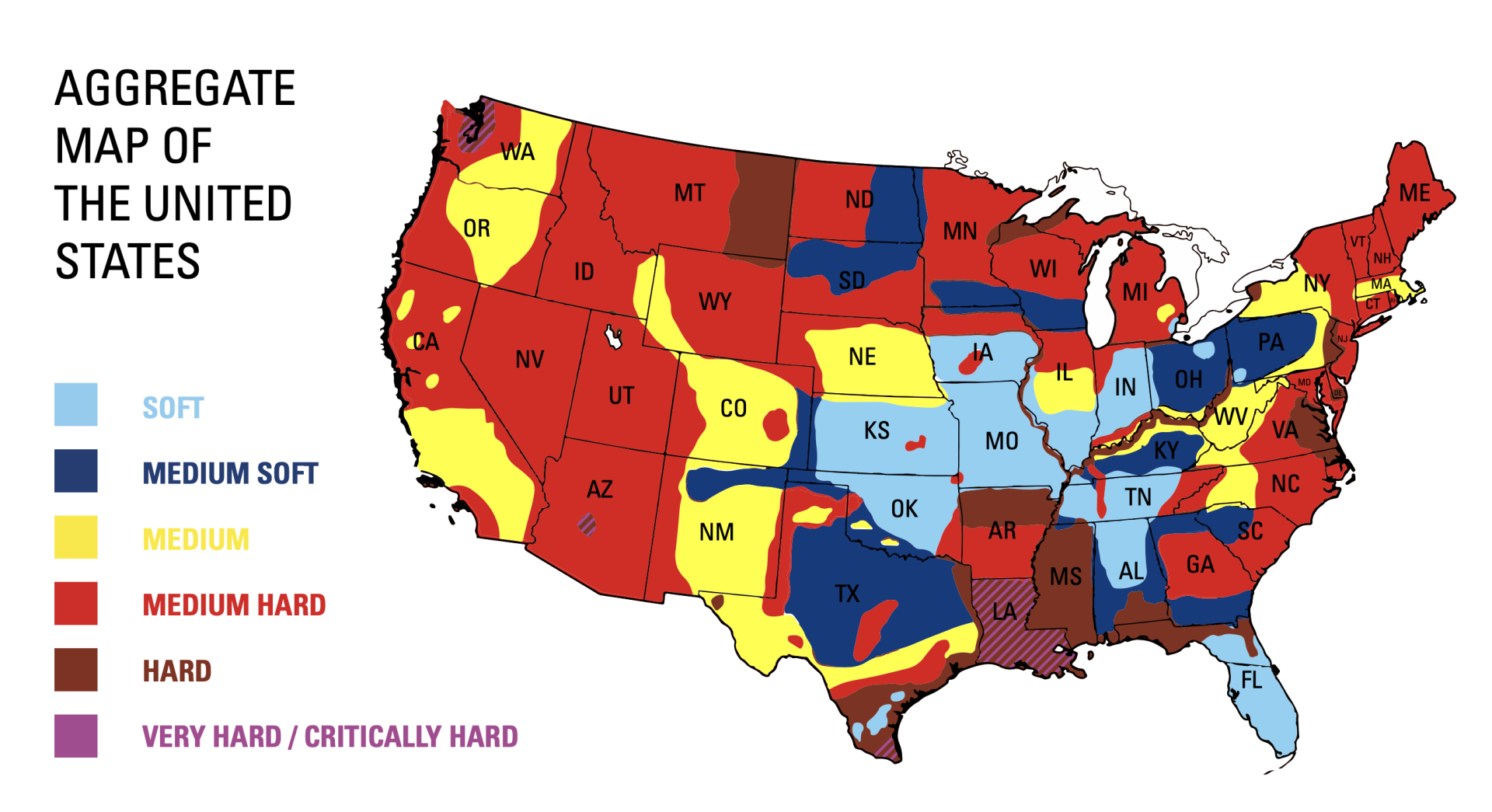
This aggregate map is not intended, nor should it be used to precisely define all aggregate in a given area. Instead, it is published as a “general guide” to the predominant aggregate hardness (as it relates to sawability) likely to be encountered in the areas defined by the various colors.
It should also be pointed out that any aggregate can be sawed. However, the cost of sawing is usually directly related to aggregate hardness & size. This map is simply a reference tool to provide a general sense of aggregate similarity in various areas of the country. A brief description of the predominant aggregate in each state follows.
ALABAMA Aggregates vary from favorable materials such as limestone, sandstone, & blast furnace slag to hard materials, such as quartzite & chert. The harder aggregate materials are found in the Central & Southwest sections of the state. ALASKA The predominant aggregates are gravel & crushed rock & would be classified as medium-hard.
ARIZONA A medium-hard gravel aggregate is encountered in most of the state & a medium-soft decomposed granite in some areas in the northern part of the state. The sand content tends to be highly abrasive.
ARKANSAS A medium-hard granite aggregate is encountered in the southern two thirds of the state & a hard chert river gravel aggregate in the northern & north-eastern part of the state. CALIFORNIA Medium-hard gravel aggregates are encountered in the El Centro through San Diego area as well as in the northern part of the state. A medium to medium-soft aggregate is encountered in the San Clemente, Los Angeles, Paso Robles, Lancaster & Bakersfield area.
COLORADO The northern part of the state has medium to medium-soft aggregate comprised of decomposed granite. The Denver area & south eastern & eastern sections have medium-soft decomposed granite, limestone & gravel. The Colorado Springs area consists of a medium-hard gravel.
CONNECTICUT Generally the aggregates consist of medium to medium-hard trap rock & dolomite. DELAWARE The major portion of the state contains medium-soft trap rock & limestone aggregates. The Wilmington area does produce a medium-hard gravel aggregate.
FLORIDA Generally the aggregates are composed of soft shell & argillaceous, siliceous & dolomitic limestone. The northern area sometimes uses hard Georgia & Alabama aggregates.
GEORGIA Aggregates in the northern part of the state are medium-soft sandstone & limestone. The southern three-quarters of the state has medium-hard to hard granite, schist, gneiss & quartzite aggregates.
HAWAII Aggregate conditions throughout the islands are of the medium-hard, basaltic type.
IDAHO Generally medium-hard crushed stone & gravel aggregates.
ILLINOIS Aggregates in this state may be divided into three sections, the northern area medium to hard gravel, the central section medium gravel & limestone, the southern area soft limestone. INDIANA The state has generally soft crushed limestone except in the southern & north-western sections where medium-hard Ohio & Wabash river gravel occur.
IOWA In the Des Moines & central Iowa area medium-hard pit & river gravel are typical. Aggregates found in the eastern, central & south- western sections are soft limestone. The eastern border along the Mississippi River has hard chert river gravel. Medium-hard pit gravel with quartzite is found in the north-western section.
KANSAS The aggregate conditions generally found are soft limestone. Medium-hard limestone, dolomite & hard chert gravel are found in the south-eastern section, & medium-hard pit gravel in the north central area.
KENTUCKY Approximately 90% of the state has aggregates of medium-soft limestone & sandstone. The northern section along the Ohio River has medium-hard quartzite river gravel.
LOUISIANA Aggregate conditions in the state range from soft shell to hard chert.
MAINE in general a medium-hard dolomitic gravel & some trap rock is encountered in this state. MARYLAND About 60% of the state has medium- soft limestone aggregate. The balance of the state has medium-hard river gravel.
MASSACHUSETTS The aggregate generally found is medium trap rock except in northern section bordering New Hampshire where the aggregate is medium-hard
MICHIGAN Generally medium-hard glacial gravel is found. The Pontiac, Flint, Mount Clemens area contains fair amounts of hard chert or flint. MINNESOTA Aggregate in the central & northern part of the state consists of medium-hard glacial gravel, In the southern section medium-soft quarried limestone prevails.
MISSISSIPPI Hard & medium-hard aggregates are found in the southwest section of the state & consist of chert & quartzite.
MISSOURI Soft limestone aggregate predominates in this state with a hard chert aggregate in the St. Louis area (Meramec River gravel) & a similar hard flint aggregate in the Joplin area.
MONTANA The eastern section is a hard aggregate area, the Great Falls area contains a medium-hard gravel & crushed stone aggregate & the Glasgow & Miles City areas have a hard quartz & chert aggregate.
NEBRASKA Eastern & Central sections contain a medium limestone & gravel mixture & the Western areas have a straight medium-hard gravel aggregate.
NEVADA The predominant aggregates are medium to medium-hard gravel & crushed decomposed granite.
NEW HAMPSHIRE Generally medium-hard to hard granitic gravel aggregates are encountered.
NEW JERSEY The predominant aggregates are a medium trap rock & a hard river gravel.
NEW MEXICO Northern areas contain medium- soft aggregate shipped in from Colorado. A medium limestone with some quartz aggregate is encountered in the southern part of the state (Gallup, Alamogordo, Deming & Lordsburg). The Tucumcari area has a medium-hard gravel aggregate. A medium-hard to hard gravel is encountered in the Albuquerque area.
NEW YORK There are three predominant aggregates in this state, a medium-soft limestone, medium trap rock & medium to medium-hard granitic gravel.
NORTH CAROLINA Medium-hard & hard aggregates exist throughout the state & consist of granites, schist, gneiss & quartzite. There is some scattering of a medium limestone.
NORTH DAKOTA In general a medium-hard glacial gravel is encountered consisting of limestone, granitic gneiss, basalt, quartzite & chert. In the eastern half of the state the aggregate combinations are medium-soft.
OHIO Generally a medium-soft pit gravel is encountered throughout the state except in the areas along the Ohio River where a medium-hard river bed aggregate is used.
OKLAHOMA Soft limestone is generally encountered except in the western section where a medium-hard granite aggregate is used. OREGON The western section contains a hard granite aggregate & on the east side of the mountains a medium crushed gravel is encountered.
PENNSYLVANIA Generally medium-soft limestone & medium trap rock aggregate are encountered except in steel mill areas where soft slag might be used. Pit gravel is commonly used in the Philadelphia area.
RHODE ISLAND A medium hard trap rock aggregate is generally used throughout the state.
SOUTH CAROLINA Predominantly the aggregates consist of medium-hard quartzite, granite & gneiss with some limited amounts of medium-soft crushed limestone & marble.
SOUTH DAKOTA There are three types of aggregate encountered in this state. The eastern area consists of hard quartzitic aggregate, the central portion has a medium-hard gravel aggregate & soft limestone aggregates in the western section.
TENNESSEE In general medium-hard aggregates are encountered throughout the state with some medium-hard quartzite west of Mashville & hard chert aggregates along the Mississippi River. TEXAS The predominant aggregates encountered consist of medium-soft limestone & dolomite with some medium-hard quartzite around the San Antonio area & hard chert along the Gulf Coast area.
UTAH Aggregates consist of medium-hard gravel throughout the state.
VERMONT In general medium to medium-hard granitic gravel aggregate is encountered throughout the state. Large aggregate is often encountered.
VIRGINIA Medium-hard granite aggregates are normally encountered throughout the state with medium-hard to hard river gravel in the Norfolk & Washington, D.C. areas.
WASHINGTON Medium to medium-hard gravel & crushed stone aggregates are encountered on the eastern side of the mountains & hard gravel aggregates on the western side & in the Seattle & Tacoma areas.
WEST VIRGINIA The predominant aggregates consist of a medium-soft limestone, except along the Kanawha River where medium-hard to hard river gravel aggregates are used.
WISCONSIN The southern section of the state contains medium-soft limestone & gravel aggregates. The northern sections have a medium-soft glacial aggregate.
WYOMING Medium to medium-soft limestone & crushed rock are encountered throughout the state.

© 2026 Caterpillar. All Rights Reserved. CAT, CATERPILLAR, LET’S DO THE WORK, their respective logos, "Caterpillar Corporate Yellow", the "Power Edge" and Cat “Modern Hex” trade dress as well as corporate and product identity used herein, are trademarks of Caterpillar and may not be used without permission. C6 DIAMOND INC, a licensee of Caterpillar Inc.
© 2026 Cat® Diamond Tools